




Quantum Resistant Ledger
QRL Price
How is the price of Quantum Resistant Ledger (QRL) calculated?
The price of Quantum Resistant Ledger (QRL) is calculated in real-time by aggregating the latest data across 5 exchanges and 5 markets, using a global volume-weighted average formula. Learn more about how crypto prices are calculated on CoinGecko.



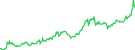
Quantum Resistant Ledger Price Chart (QRL)
Switch & Compare
| 1h | 24h | 7d | 14d | 30d | 1y |
|---|---|---|---|---|---|
| 0.4% | 1.6% | 4.4% | 4.9% | 9.2% | 34.1% |
QRL Converter
Quantum Resistant Ledger Statistics
|
Market Cap
Market Cap = Current Price x Circulating Supply
Refers to the total market value of a cryptocurrency’s circulating supply. It is similar to the stock market’s measurement of multiplying price per share by shares readily available in the market (not held & locked by insiders, governments) Read More |
$75,403,538 |
|---|---|
|
Market Cap / FDV
The proportion of current market capitalization compares to market capitalization when meeting max supply.
The closer the Mkt Cap/FDV to 1, the closer the current market capitalization to its fully diluted valuation and vice versa. Learn more about Mkt Cap/FDV here. |
1.0 |
|
Fully Diluted Valuation
Fully Diluted Valuation (FDV) = Current Price x Total Supply
Fully Diluted Valuation (FDV) is the theoretical market capitalization of a coin if the entirety of its supply is in circulation, based on its current market price. The FDV value is theoretical as increasing the circulating supply of a coin may impact its market price. Also depending on the tokenomics, emission schedule or lock-up period of a coin's supply, it may take a significant time before its entire supply is released into circulation. Learn more about FDV here. |
$75,403,538 |
|
24 Hour Trading Vol
A measure of a cryptocurrency trading volume across all tracked platforms in the last 24 hours. This is tracked on a rolling 24-hour basis with no open/closing times.
Read More |
$41,244.16 |
|
Circulating Supply
The amount of coins that are circulating in the market and are tradeable by the public. It is comparable to looking at shares readily available in the market (not held & locked by insiders, governments).
Read More |
78,392,960 |
|
Total Supply
The amount of coins that have already been created, minus any coins that have been burned (removed from circulation). It is comparable to outstanding shares in the stock market.
Total Supply = Onchain supply - burned tokens |
78,392,960 |
|
Max Supply
The maximum number of coins coded to exist in the lifetime of the cryptocurrency. It is comparable to the maximum number of issuable shares in the stock market.
Max Supply = Theoretical maximum as coded |
105,000,000 |
 Sponsored
Sponsored
Sponsored
Sponsored
Sponsored
QRL Historical Price
| 24h Range | $0.9496 – $1.00 |
|---|---|
| 7d Range | $0.9329 – $1.03 |
| All-Time High |
$3.87 75.1%
Jan 09, 2018 (over 8 years)
|
| All-Time Low |
$0.04117 2236.4%
Dec 01, 2023 (over 2 years)
|
How do you feel about QRL today?
About Quantum Resistant Ledger (QRL)
Quantum Resistant Ledger is a decentralized blockchain platform specifically engineered to secure digital assets and communications against the future threat of quantum computing attacks.
- Post-Quantum Security: It is the first industrial blockchain implementation to utilize eXtended Merkle Signature Scheme (XMSS), a hash-based digital signature scheme that is secure against both classical and quantum computer threats.
- NIST Compliance: The platform’s security architecture relies on XMSS, which is a signature scheme approved by the National Institute of Standards and Technology (NIST) for its resistance to quantum decryption.
- Comprehensive Ecosystem: Beyond its secure ledger, the project provides a suite of user-facing tools including desktop, mobile, and web wallets, along with hardware wallet integration for secure asset custody.
What Is Quantum Resistant Ledger
Quantum Resistant Ledger (QRL) is a Layer 1 blockchain designed to provide long-term stability and durability in an era where advancing quantum technology could potentially compromise traditional cryptographic methods used by Bitcoin and Ethereum. The core value proposition is "future-proofing" digital wealth by ensuring that the underlying signatures used to authorize transactions cannot be broken by powerful quantum processors.
Value moves through the system via the native QRL token, which is used to incentivize network participants and facilitate decentralized communication. The token is put to work through network security and transactional utility. Currently, the network utilizes a Proof of Work consensus mechanism where miners secure the ledger in exchange for block rewards. As the ecosystem grows, the project aims to scale its security through the development of post-quantum secure smart contracts and a transition to a Proof of Stake model, which would allow holders to participate directly in network validation.
What Makes Quantum Resistant Ledger Unique
- XMSS Implementation: Unlike most blockchains that rely on ECDSA or Ed25519 signatures—which are theoretically vulnerable to Shor's algorithm—QRL uses XMSS from the genesis block, ensuring no legacy addresses are exposed to quantum risk.
- Audited Cryptography: The platform's post-quantum cryptography library and core codebase have undergone multiple third-party security audits by firms such as Halborn, Red4Sec, and X41 D-Sec to validate its industrial-grade security.
- EnQlave Integration: The project developed EnQlave, a solution designed to bring QRL's post-quantum security features to the Ethereum platform, allowing users to secure Ethereum-based assets with quantum-resistant protection.
- Ephemeral Messaging Layer: QRL features a first-of-its-kind secure messaging layer that combines on-chain lattice key storage with ephemeral messaging to provide ultra-secure, post-quantum digital communications.
What Can You Use Quantum Resistant Ledger for?
- Secure Asset Custody: Users can hold and transfer QRL tokens using a variety of audited wallets, including full support for Ledger hardware devices, ensuring that their private keys are protected by quantum-resistant signatures.
- Network Security through Mining: Participants can contribute to the network's security by mining using the RandomX algorithm, earning QRL tokens as compensation for providing computational power to the decentralized ledger.
- Document Notarization: The platform supports post-quantum document notarization, allowing users to create immutable, time-stamped proofs of digital documents that remain verifiable even in a post-quantum environment.
- Protocol Service Fees: The native token is used to pay gas fees for all on-chain interactions, including standard transactions, message broadcasting, and token creation within the ecosystem.
How Does Quantum Resistant Ledger Work?
Quantum Resistant Ledger operates using a hash-based signature scheme called XMSS (eXtended Merkle Signature Scheme). Unlike traditional signatures that rely on the mathematical difficulty of factoring large numbers or solving discrete logarithms, XMSS relies on the security of cryptographic hash functions. This makes it "forward-secure," meaning that even if a future discovery compromises a specific key, previous signatures remain protected.
The network currently utilizes RandomX, a Proof of Work consensus mechanism that is optimized for general-purpose CPUs, preventing the centralization of mining power in specialized hardware. Every transaction on the ledger requires a small amount of gas fees paid in the native token to prevent spam and compensate the decentralized network of nodes for processing data. The project is actively developing a transition to a post-quantum secure Proof of Stake mechanism, which will replace computational mining with a system where validators are selected based on the tokens they hold and commit to the network's security.
Team Info and Investors
Quantum Resistant Ledger was founded by Peter Waterland, a researcher who identified the long-term vulnerability of existing blockchain signatures to quantum computing. The project is supported by the QRL Foundation, a non-profit entity dedicated to the research, development, and promotion of post-quantum secure blockchain technology. The development team is comprised of a global group of core blockchain developers, analysts, and security experts. While the project emphasizes its open-source and community-driven nature, its technical implementation has been verified through extensive external audits. The project has established partnerships with various research-focused organizations, including Geometry Labs, to advance the field of lattice-based and hash-based cryptography.
Where can you buy Quantum Resistant Ledger?
QRL tokens can be traded on centralized crypto exchanges. The most popular exchange to buy and trade Quantum Resistant Ledger is MEXC, where the most active trading pair QRL/USDT has a trading volume of $33,097.75 in the last 24 hours. Other popular options include Biconomy.com and Tapbit.
What is the daily trading volume of Quantum Resistant Ledger (QRL)?
The trading volume of Quantum Resistant Ledger (QRL) is $41,244.16 in the last 24 hours, representing a 57.60% increase from one day ago and signalling a recent rise in market activity. Check out CoinGecko’s list of highest volume cryptocurrencies.
What is the highest and lowest price for Quantum Resistant Ledger (QRL)?
Quantum Resistant Ledger (QRL) reached an all-time high of $3.87 and an all-time low of $0.04117. It’s now trading -75.10% below that peak and 2,236.40% above its lowest price.
What is the market cap of Quantum Resistant Ledger (QRL)?
Market capitalization of Quantum Resistant Ledger (QRL) is $75,403,565 and is ranked #319 on CoinGecko today. Market cap is measured by multiplying token price with the circulating supply of QRL tokens (78 Million tokens are tradable on the market today).
What is the fully diluted valuation of Quantum Resistant Ledger (QRL)?
The fully diluted valuation (FDV) of Quantum Resistant Ledger (QRL) is $75,403,565. This is a statistical representation of the maximum market cap, assuming the maximum number of 110 Million QRL tokens are in circulation today. Depending on how the emission schedule of QRL tokens are designed, it might take multiple years before FDV is realized.
How does the price performance of Quantum Resistant Ledger compare against its peers?
With a price decline of -4.40% in the last 7 days, Quantum Resistant Ledger (QRL) is underperforming the global cryptocurrency market which is down -2.30%, while outperforming when compared to similar Smart Contract Platform cryptocurrencies which are down -5.30%.
Quantum Resistant Ledger (QRL) Security Ratings
Quantum Resistant Ledger Markets
| # | Exchange | Pair | Price | Spread | +2% Depth | -2% Depth | 24h Volume | Volume % | Last Updated | |
|---|---|---|---|---|---|---|---|---|---|---|
| 1 |
CEX
|
$0.960639634316680817188 | 0.4% | $183 | $1,913 | $33,097.00 | 80.13% |
Recently
|
||
| 2 |
CEX
|
$0.9682952831413926 | 1.38% | $334 | $1,373 | $6,366.00 | 15.43% |
Recently
|
||
| 3 |
CEX
|
$0.96190917044414661897 | 1.86% | $824 | $814 | $1,346.00 | 3.26% |
Recently
|
||
| 4 |
CEX
|
$0.9609681827514360828 | 1.55% | $222 | $2,633 | $434.00 | 1.05% |
Recently
|
||
| 5 |
CEX
|
$0.969493174213320096 | 1.38% | $580 | $1,651 | $10,175.00 | 24.67% |
Recently
Anomaly - Trading price or volume is an outlier against the average
|
||


You may be interested in these latest crypto news


You may be interested in these crypto articles


Global Quantum Resistant Ledger Prices
Related Coins You May Like
















 GeckoAI














 Or check it out in the app stores