


SEALCOIN Secures $4M Investment for Space Economy Blockchain Infrastructure
1 source



How is the price of QAIT (QAIT) calculated?
The price of QAIT (QAIT) is calculated in real-time by aggregating the latest data across 8 exchanges and 8 markets, using a global volume-weighted average formula. Learn more about how crypto prices are calculated on CoinGecko.


SEALCOIN Secures $4M Investment for Space Economy Blockchain

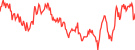
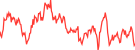
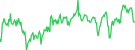
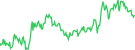
| 1h | 24h | 7d | 14d | 30d | 1y |
|---|---|---|---|---|---|
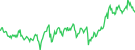
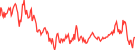
| 0.1% | 11.3% | 17.8% | 17.3% | - | - |
|
Market Cap
Market Cap = Current Price x Circulating Supply
Refers to the total market value of a cryptocurrency’s circulating supply. It is similar to the stock market’s measurement of multiplying price per share by shares readily available in the market (not held & locked by insiders, governments) Read More |
$17,799,575 |
|---|---|
|
Market Cap / FDV
The proportion of current market capitalization compares to market capitalization when meeting max supply.
The closer the Mkt Cap/FDV to 1, the closer the current market capitalization to its fully diluted valuation and vice versa. Learn more about Mkt Cap/FDV here. |
0.16 |
|
Fully Diluted Valuation
Fully Diluted Valuation (FDV) = Current Price x Total Supply
Fully Diluted Valuation (FDV) is the theoretical market capitalization of a coin if the entirety of its supply is in circulation, based on its current market price. The FDV value is theoretical as increasing the circulating supply of a coin may impact its market price. Also depending on the tokenomics, emission schedule or lock-up period of a coin's supply, it may take a significant time before its entire supply is released into circulation. Learn more about FDV here. |
$111,885,071 |
|
24 Hour Trading Vol
A measure of a cryptocurrency trading volume across all tracked platforms in the last 24 hours. This is tracked on a rolling 24-hour basis with no open/closing times.
Read More |
$8,922,508 |
|
Circulating Supply
The amount of coins that are circulating in the market and are tradeable by the public. It is comparable to looking at shares readily available in the market (not held & locked by insiders, governments).
Read More |
1,049,977,388
Available Supply
6,599,977,388
Locked wallet
(0xab7b)
- 5,550,000,000
Est. Circulating Supply
1,049,977,388
|
|
Total Supply
The amount of coins that have already been created, minus any coins that have been burned (removed from circulation). It is comparable to outstanding shares in the stock market.
Total Supply = Onchain supply - burned tokens |
6,599,977,388 |
|
Max Supply
The maximum number of coins coded to exist in the lifetime of the cryptocurrency. It is comparable to the maximum number of issuable shares in the stock market.
Max Supply = Theoretical maximum as coded |
10,000,000,000 |
 Sponsored
Sponsored
Sponsored
Sponsored
Sponsored
| 24h Range | $0.01674 – $0.01919 |
|---|---|
| 7d Range | $0.01688 – $0.02177 |
| All-Time High |
$0.1897 91.1%
May 28, 2026 (29 days)
|
| All-Time Low |
$0.01268 33.6%
May 28, 2026 (29 days)
|
SEALCOIN (QAIT) is a decentralized physical infrastructure network (DePIN) and protocol designed to establish a foundational trust layer for the autonomous machine economy.
SEALCOIN is a foundational infrastructure layer developed to facilitate the autonomous economic interaction of machines and artificial intelligence agents. The platform allows these entities to operate as independent actors capable of discovering services, negotiating value, and settling payments. By providing a tamper-proof settlement layer, SEALCOIN aims to address the scalability and security challenges inherent in the rapidly expanding Internet of Things (IoT) ecosystem.
The native utility and payment instrument of the ecosystem is the QAIT token. It is used to settle device-to-device payments, access platform services, and provide incentive mechanisms that encourage participation in the network infrastructure. To ensure economic predictability for businesses, the protocol allows services to be priced in fiat currency references while the actual settlement is executed dynamically in QAIT.
SEALCOIN operates through a multi-layered architecture that combines physical hardware security with decentralized ledger technology. The protocol utilizes a Proof of Security (PoSy) mechanism, which is a method designed to align governance, token utility, and economic incentives within the network. This framework abstracts complex physical identities into programmatic, on-chain value exchanges, allowing machines to act as self-governing economic actors.
The infrastructure leverages high-throughput networks, such as Hedera, to ensure real-time settlement and enterprise-grade performance. Transaction fees within the ecosystem are managed as protocol service fees using the QAIT token, which functions as both the medium of exchange and the access tool for network services. This dual role ensures that the token's value is directly tied to the level of activity and service consumption within the machine economy.
SEALCOIN was developed by SEALCOIN AG, a Swiss-based subsidiary of WISeKey International Holding Ltd. (NASDAQ: WKEY). The project was established in partnership with The Hashgraph Group AG to bridge physical hardware security with distributed ledger technology. The economic framework and governance of the ecosystem are managed by the independent QAIT Association, which is based in Zurich, Switzerland, and oversees the long-term development of the protocol.
QAIT tokens can be traded on decentralized exchanges and centralized crypto exchanges. The most popular exchange to buy and trade QAIT is Pancakeswap Infinity CLMM (BSC), where the most active trading pair QAIT/BSC-USD has a trading volume of $8,294,447.62 in the last 24 hours. Other popular options include Gate and KuCoin.
The trading volume of QAIT (QAIT) is $8,937,378.81 in the last 24 hours, representing a 13.70% increase from one day ago and signalling a recent rise in market activity. Check out CoinGecko’s list of highest volume cryptocurrencies.
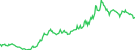
QAIT (QAIT) reached an all-time high of $0.1897 and an all-time low of $0.01268. It’s now trading -91.10% below that peak and 33.60% above its lowest price.
Market capitalization of QAIT (QAIT) is $17,768,025 and is ranked #861 on CoinGecko today. Market cap is measured by multiplying token price with the circulating supply of QAIT tokens (1 Billion tokens are tradable on the market today).
The fully diluted valuation (FDV) of QAIT (QAIT) is $111,686,749. This is a statistical representation of the maximum market cap, assuming the maximum number of 10 Billion QAIT tokens are in circulation today. Depending on how the emission schedule of QAIT tokens are designed, it might take multiple years before FDV is realized.
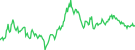
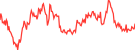
With a price decline of -17.90% in the last 7 days, QAIT (QAIT) is underperforming the global cryptocurrency market which is down -4.60%, while underperforming when compared to similar BNB Chain Ecosystem cryptocurrencies which are up 0.00%.
Adding QAIT (QAIT) to MetaMask allows you to view your token holdings, trade on decentralized exchanges, and more. To add them, you’ll need to import QAIT as a token. You can copy QAIT’s contract address (0x4d41a5d412f4ef44a35b9f53b06db65ede249493) and import it manually, or if you've installed MetaMask's chrome extension, add QAIT to MetaMask with one click on CoinGecko.
Add QAIT to MetaMask.
| # | Exchange | Pair | Price | Spread | +2% Depth | -2% Depth | 24h Volume | Volume % | Last Updated | |
|---|---|---|---|---|---|---|---|---|---|---|
| 1 |
DEX
|

|
$0.01692 | 0.6% | $30,004 | $29,914 | $8,294,447 | 92.68% |
Recently
|
|
| 2 |
CEX
|
$0.01694 | 0.41% | $4,486 | $4,958 | $230,976 | 2.58% |
Recently
|
||
| 3 |
CEX
|
$0.01684 | 0.41% | $7,990 | $1,968 | $231,952 | 2.59% |
Recently
|
||
| 4 |
CEX
|
$0.01691 | 0.45% | $976 | $926 | $115,235 | 1.29% |
Recently
|
||
| 5 |
CEX
|
$0.01691 | 0.86% | $316 | $5,332 | $30,900.00 | 0.35% |
Recently
|
||
| 6 |
DEX
|
|
$0.01690 | 0.63% | $181 | $181 | $5,995.00 | 0.07% |
Recently
|
|
| 7 |
CEX
|
$0.01687 | 0.84% | $2,926 | $5,014 | $27,871.00 | 0.31% |
Recently
|
||
| 8 |
DEX
|
|
$0.01857 | -1.29% | $20 | $20 | $5,254.00 | 0.06% |
about 18 hours ago
Inactive - No trades in the last 3 hours
|
|









 GeckoAI


 Or check it out in the app stores