





Seasons
SEAS Price
How is the price of Seasons (SEAS) calculated?
The price of Seasons (SEAS) is calculated in real-time by aggregating the latest data across 2 exchanges and 10 markets, using a global volume-weighted average formula. Learn more about how crypto prices are calculated on CoinGecko.



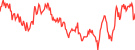
Seasons Price Chart (SEAS)
Switch & Compare
| 1h | 24h | 7d | 14d | 30d | 1y |
|---|---|---|---|---|---|
| 0.4% | 7.9% | 3.3% | 4.4% | - | - |
SEAS Converter
Seasons Statistics
|
Market Cap
Market Cap = Current Price x Circulating Supply
Refers to the total market value of a cryptocurrency’s circulating supply. It is similar to the stock market’s measurement of multiplying price per share by shares readily available in the market (not held & locked by insiders, governments) Read More |
- Submit |
|---|---|
|
Fully Diluted Valuation
Fully Diluted Valuation (FDV) = Current Price x Total Supply
Fully Diluted Valuation (FDV) is the theoretical market capitalization of a coin if the entirety of its supply is in circulation, based on its current market price. The FDV value is theoretical as increasing the circulating supply of a coin may impact its market price. Also depending on the tokenomics, emission schedule or lock-up period of a coin's supply, it may take a significant time before its entire supply is released into circulation. Learn more about FDV here. |
$319,452,785 |
|
24 Hour Trading Vol
A measure of a cryptocurrency trading volume across all tracked platforms in the last 24 hours. This is tracked on a rolling 24-hour basis with no open/closing times.
Read More |
$6,885.93 |
|
Circulating Supply
The amount of coins that are circulating in the market and are tradeable by the public. It is comparable to looking at shares readily available in the market (not held & locked by insiders, governments).
Read More |
- |
|
Total Supply
The amount of coins that have already been created, minus any coins that have been burned (removed from circulation). It is comparable to outstanding shares in the stock market.
Total Supply = Onchain supply - burned tokens |
1,000,000,000 |
|
Max Supply
The maximum number of coins coded to exist in the lifetime of the cryptocurrency. It is comparable to the maximum number of issuable shares in the stock market.
Max Supply = Theoretical maximum as coded |
1,000,000,000 |
 Sponsored
Sponsored
Sponsored
Sponsored
Sponsored
SEAS Historical Price
| 24h Range | $0.2917 – $0.3231 |
|---|---|
| 7d Range | $0.2864 – $0.3376 |
| All-Time High |
$0.3723 14.2%
Jun 07, 2026 (17 days)
|
| All-Time Low |
$0.2864 11.6%
Jun 20, 2026 (5 days)
|
How do you feel about SEAS today?
About Seasons (SEAS)
Seasons is an autonomous, internet-native liquidity system on the Solana blockchain designed to facilitate the generation, distribution, and accumulation of value through its Yield 3.0 mechanism.
- The protocol enables users to earn yields in a basket of alternative assets, including Bitcoin and Gold, by holding the native SEAS token.
- It operates a non-custodial node system where any wallet holding a minimum of 10,000 SEAS automatically qualifies for periodic yield distributions.
- The ecosystem is powered by three distinct yield engines that capture value from trading activity, protocol reserves, and managed DeFi strategies.
What Is Seasons
Seasons is a protocol within the Decentralized Finance (DeFi) sector that aims to transform a standard cryptocurrency wallet into a passive portfolio-building tool. Its primary value proposition is the automated distribution of "Inclusion Sets," which are quarterly baskets of established assets delivered directly to token holders.
Value moves through the system via the Yield 3.0 framework, which sources yield from internal protocol mechanisms rather than inflationary token emissions. The SEAS token is "put to work" primarily as an access key to the protocol's distribution network; by maintaining a minimum balance, users activate their wallet as a node. This system is designed to scale as ecosystem volume increases, with higher trading activity and larger protocol reserves leading to greater yield potential for all active nodes. If the source material does not describe a specific scaling mechanism for a feature, it is noted that no such mechanism is specified.
What Makes Seasons Unique
- Inclusion Set Model: Unlike many protocols that pay rewards in their own native inflationary tokens, Seasons distributes yield in established assets like Bitcoin, Tether Gold, and yield-bearing stablecoins.
- Hardware-Free Nodes: The protocol defines a "node" simply as a wallet meeting the 10,000 SEAS threshold. This removes the need for specialized hardware, technical setup, or manual staking/locking of assets.
- Autonomous Distribution: Yield is sent automatically to eligible wallets twice a week (typically Wednesdays and Sundays) without requiring users to manually claim rewards or interact with a dashboard.
- Non-Custodial Architecture: Users retain full control of their SEAS tokens and received yield at all times, as the protocol does not require users to deposit or lock funds into a third-party contract.
What Can You Use Seasons for?
- Node Activation: Holding at least 10,000 SEAS activates a wallet as a node, making it eligible for automated yield distributions.
- Yield Receipt: Active nodes receive regular payouts in a diversified basket of assets, facilitating passive portfolio growth.
- Governance Participation: Node holders are granted voting rights within the DAO (Decentralized Autonomous Organization) to influence protocol parameters, such as the composition of future Inclusion Sets.
- Value Retention: The protocol provides exposure to the growth of the Seasons ecosystem while simultaneously distributing assets that have historically served as stores of value.
How Does Seasons Work?
Seasons operates on Solana, a Layer 1 blockchain that uses a Proof of Stake consensus mechanism. The core of the protocol is the Yield 3.0 system, which consists of three interconnected engines:
- TTT (Transactional Transfer Tax): A 10% protocol service fee is applied to every SEAS trade. These fees are autonomously converted into yield assets and distributed to the node network.
- SSYM (Stablecoin Yield Module): This module manages protocol reserves by lending them through overcollateralized DeFi platforms to generate baseline returns and provide buy pressure for the SEAS token.
- YAV (Yield Asset Vaults): These are smart contract circuits that deploy reserves into managed strategies, such as liquidity pools, lending, and delta-neutral farming.
The entire process is coordinated by the YMS (Yield Management System), an orchestration layer that handles the sequencing, acquisition, and distribution logic of the yield assets.
Team Info and Investors
The Seasons protocol is developed and operated by a team with backgrounds in DeFi, institutional finance, and software engineering. Key leadership roles include Andrey (CEO), Caroline (CCO), Paul (CFO), and Alex (CBDO). The technical execution is supported by Pavel (Senior Software Engineer), Rupert (Data Engineer), and Philipp (AI & Data Engineer). Community and design efforts are led by Shiladitya (Content & Community), Yuris (Head of Design), and Katarina (Designer UI/UX). While the protocol emphasizes autonomous operation, the team manages the initial inclusion frameworks and protocol maturation. Documentation does not specify early venture backing or private investment rounds.
Where can you buy Seasons?
SEAS tokens can be traded on decentralized exchanges. The most popular exchange to buy and trade Seasons is Raydium (CLMM), where the most active trading pair SEAS/USDC has a trading volume of $5,656.84 in the last 24 hours.
What is the daily trading volume of Seasons (SEAS)?
The trading volume of Seasons (SEAS) is $6,885.93 in the last 24 hours, representing a -46.30% decrease from one day ago and signalling a recent fall in market activity. Check out CoinGecko’s list of highest volume cryptocurrencies.
What is the highest and lowest price for Seasons (SEAS)?
Seasons (SEAS) reached an all-time high of $0.3723 and an all-time low of $0.2864. It’s now trading -14.20% below that peak and 11.60% above its lowest price.
What is the fully diluted valuation of Seasons (SEAS)?
The fully diluted valuation (FDV) of Seasons (SEAS) is $319,452,785. This is a statistical representation of the maximum market cap, assuming the maximum number of 1 Billion SEAS tokens are in circulation today. Depending on how the emission schedule of SEAS tokens are designed, it might take multiple years before FDV is realized.
How does the price performance of Seasons compare against its peers?
With a price increase of 3.30% in the last 7 days, Seasons (SEAS) is outperforming the global cryptocurrency market which is down -3.30%, while outperforming when compared to similar Solana Ecosystem cryptocurrencies which are up 0.00%.
Seasons Markets
| # | Exchange | Pair | Price | Spread | +2% Depth | -2% Depth | 24h Volume | Volume % | Last Updated | |
|---|---|---|---|---|---|---|---|---|---|---|
| 1 |
DEX
|

|
$0.31947731631210313991020893 | 0.6% | $16,624 | $16,574 | $5,656.00 | 82.15% |
Recently
|
|
| 2 |
DEX
|
|
$0.31933349836622457325813768 | 0.6% | $4,382 | $4,368 | $1,226.00 | 17.82% |
Recently
|
|
| 3 |
DEX
|
|
$0.32266259705261236141167136 | 0.77% | $46 | $46 | $2.00 | 0.03% |
Recently
|
|
| 4 |
DEX
|
|
$0.3216357012049986439855906508362912 | 0.79% | $42 | $42 | $4.00 | 0.06% |
about 9 hours ago
Inactive - No trades in the last 3 hours
|
|
| 5 |
DEX
|
|
$0.3191766459181389510948662265735664 | 0.79% | $42 | $42 | $4.00 | 0.06% |
about 9 hours ago
Inactive - No trades in the last 3 hours
|
|
| 6 |
DEX
|
|
$0.32160442018300044611559776 | 0.8% | $43 | $43 | $1.00 | 0.03% |
Recently
|
|


You may be interested in these latest crypto news


You may be interested in these crypto articles


Global Seasons Prices
Related Coins You May Like












 GeckoAI














 Or check it out in the app stores