





Small Thing
ST Price
How is the price of Small Thing (ST) calculated?
The price of Small Thing (ST) is calculated in real-time by aggregating the latest data across 3 exchanges and 3 markets, using a global volume-weighted average formula. Learn more about how crypto prices are calculated on CoinGecko.



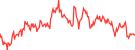
Small Thing Price Chart (ST)
Switch & Compare
| 1h | 24h | 7d | 14d | 30d | 1y |
|---|---|---|---|---|---|
| 0.3% | 8.9% | 18.7% | 12.3% | 35.3% | - |
ST Converter
Small Thing Statistics
|
Market Cap
Market Cap = Current Price x Circulating Supply
Refers to the total market value of a cryptocurrency’s circulating supply. It is similar to the stock market’s measurement of multiplying price per share by shares readily available in the market (not held & locked by insiders, governments) Read More |
$35,099,309 |
|---|---|
|
Market Cap / FDV
The proportion of current market capitalization compares to market capitalization when meeting max supply.
The closer the Mkt Cap/FDV to 1, the closer the current market capitalization to its fully diluted valuation and vice versa. Learn more about Mkt Cap/FDV here. |
0.4 |
|
Fully Diluted Valuation
Fully Diluted Valuation (FDV) = Current Price x Total Supply
Fully Diluted Valuation (FDV) is the theoretical market capitalization of a coin if the entirety of its supply is in circulation, based on its current market price. The FDV value is theoretical as increasing the circulating supply of a coin may impact its market price. Also depending on the tokenomics, emission schedule or lock-up period of a coin's supply, it may take a significant time before its entire supply is released into circulation. Learn more about FDV here. |
$88,046,626 |
|
24 Hour Trading Vol
A measure of a cryptocurrency trading volume across all tracked platforms in the last 24 hours. This is tracked on a rolling 24-hour basis with no open/closing times.
Read More |
$26,299.84 |
|
Circulating Supply
The amount of coins that are circulating in the market and are tradeable by the public. It is comparable to looking at shares readily available in the market (not held & locked by insiders, governments).
Read More |
398,644,565
|
|
Total Supply
The amount of coins that have already been created, minus any coins that have been burned (removed from circulation). It is comparable to outstanding shares in the stock market.
Total Supply = Onchain supply - burned tokens |
1,000,000,000 |
|
Max Supply
The maximum number of coins coded to exist in the lifetime of the cryptocurrency. It is comparable to the maximum number of issuable shares in the stock market.
Max Supply = Theoretical maximum as coded |
1,000,000,000 |
 Sponsored
Sponsored
Sponsored
Sponsored
Sponsored
ST Historical Price
| 24h Range | $0.001490 – $0.001648 |
|---|---|
| 7d Range | $0.001492 – $0.001849 |
| All-Time High |
$0.1054 98.6%
Apr 15, 2026 (2 months)
|
| All-Time Low |
$0.001490 0.3%
Jun 23, 2026 (about 1 hour)
|
How do you feel about ST today?
About Small Thing (st)
Small Thing is a decentralized infrastructure project developing autonomous marine robots to detect, collect, and map ocean microplastics using artificial intelligence and mesh networking.
- Deploys swarms of miniature autonomous robots that coordinate ocean restoration missions without human pilots.
- Utilizes a peer-to-peer mesh network for multi-hop communication to achieve broad environmental coverage.
- Provides an open environmental dashboard with verifiable, signed data for researchers, governments, and the public.
What Is Small Thing
Small Thing is an operational network designed to automate the collection and mapping of microplastics in marine environments. The project addresses the problem of diffuse ocean pollution by deploying a fleet of small, standardized robots capable of continuous operation in ports, estuaries, and shorelines. By aggregating data from these units, the project builds a real-time ocean intelligence platform.
Value moves through the system via a framework of missions and reward pools. Sponsors, such as NGOs or municipalities, fund prize pools for specific cleanup operations. The ST token acts as an application utility token within this ecosystem; rewards are distributed to robot owners based on their measured impact, which is determined by factors like collected mass, data quality, and log integrity. This mechanism incentivizes the expansion of the fleet and ensures the maintenance of high data standards as the network grows.
What Makes Small Thing Unique
- Swarm Intelligence: Unlike traditional single-unit ocean cleaners, Small Thing uses swarms that share maps and coordinate tasks decentralizedly to optimize collection efficiency.
- Military-Grade Security: The network uses end-to-end encryption and signed logs to ensure the integrity of environmental data, making it suitable for official reporting.
- Autonomous Edge AI: Each robot features onboard artificial intelligence for navigation and plastic detection, allowing it to continue its mission even if the network connection is lost.
- Frugal Infrastructure: The robots are compact (30–50 cm) and standardized, utilizing onboard solar charging to maintain low-cost, long-term operations.
What Can You Use Small Thing for?
- Environmental Monitoring: Users can access the public dashboard to view real-time pollution density maps and time-series data on microplastic hotspots.
- Mission Sponsorship: Organizations can fund specific missions to achieve documented environmental impact, receiving verified reports for their ESG initiatives.
- Fleet Participation: Robot owners can enroll their units in active mission slots to earn protocol service fees and rewards from prize pools.
- Research and Policy: Researchers and government bodies can utilize the standardized protocols and API exports for oceanographic studies and regulatory planning.
How Does Small Thing Work?
The Small Thing architecture consists of three primary layers: the physical robotic units, the communication mesh, and the data pipeline. Each robot is equipped with a fine filtration module, ARM-based compute, and GNSS for precise time-stamping. They are designed for durability in salt and waves, powered by LiFePO4 batteries and integrated solar panels.
Communication is handled through a peer-to-peer multi-hop mesh network with a range of approximately 15 km per node. This allows the robots to talk, call for help, and self-organize without a central controller. Tasks are allocated using a decentralized auction style, where the robot with the most optimal energy levels and proximity takes the lead on a specific hotspot. All mission data is geolocated and cross-checked by multiple units; the resulting logs are hashed and chained to create a verifiable record of environmental impact.
Team Info and Investors
Small Thing is part of the Base Ecosystem and was launched on the Virtuals Protocol platform on November 3, 2025. The project follows a roadmap progressing from V0 prototypes to a V3 global replication model. Available source material does not specify individual team members or institutional investors.
Where can you buy Small Thing?
ST tokens can be traded on decentralized exchanges and centralized crypto exchanges. The most popular exchange to buy and trade Small Thing is Uniswap V2 (Base), where the most active trading pair ST/VIRTUAL has a trading volume of $1,149.99 in the last 24 hours. Other popular options include KCEX and Uniswap V3 (Base).
What is the daily trading volume of Small Thing (ST)?
The trading volume of Small Thing (ST) is $26,299.84 in the last 24 hours, representing a 4.50% increase from one day ago and signalling a recent rise in market activity. Check out CoinGecko’s list of highest volume cryptocurrencies.
What is the highest and lowest price for Small Thing (ST)?
Small Thing (ST) reached an all-time high of $0.1054 and an all-time low of $0.001490. It’s now trading -98.60% below that peak and 0.30% above its lowest price.
What is the market cap of Small Thing (ST)?
Market capitalization of Small Thing (ST) is $35,099,309 and is ranked #563 on CoinGecko today. Market cap is measured by multiplying token price with the circulating supply of ST tokens (400 Million tokens are tradable on the market today).
What is the fully diluted valuation of Small Thing (ST)?
The fully diluted valuation (FDV) of Small Thing (ST) is $88,046,626. This is a statistical representation of the maximum market cap, assuming the maximum number of 1 Billion ST tokens are in circulation today. Depending on how the emission schedule of ST tokens are designed, it might take multiple years before FDV is realized.
How does the price performance of Small Thing compare against its peers?
With a price decline of -18.70% in the last 7 days, Small Thing (ST) is underperforming the global cryptocurrency market which is down -4.90%, while underperforming when compared to similar Robotics cryptocurrencies which are down -10.60%.
Small Thing Markets
| # | Exchange | Pair | Price | Spread | +2% Depth | -2% Depth | 24h Volume | Volume % | Last Updated | |
|---|---|---|---|---|---|---|---|---|---|---|
| 1 |
DEX
|

|
$0.001499750944564604749716331168246952632036857436368 | 0.6% | $10,169 | $10,138 | $1,149.00 | 4.37% |
Recently
|
|
| 2 |
CEX
|
$0.001494249686613477156 | 1.96% | $260 | $267 | $25,149.00 | 95.61% |
Recently
|
||
| 3 |
DEX
|
|
$0.00921906083639075137170306971119232764134472270605 | 0.61% | $1,167 | $1,163 | $4.00 | 0.02% |
5 days ago
Inactive - No trades in the last 3 hours
Anomaly - Trading price or volume is an outlier against the average
|
|


You may be interested in these latest crypto news


You may be interested in these crypto articles



Global Small Thing Prices
Related Coins You May Like














 GeckoAI














 Or check it out in the app stores