





lium
SN51 Price
How is the price of lium (SN51) calculated?
The price of lium (SN51) is calculated in real-time by aggregating the latest data across 2 exchanges and 2 markets, using a global volume-weighted average formula. Learn more about how crypto prices are calculated on CoinGecko.



lium Price Chart (SN51)
Switch & Compare
| 1h | 24h | 7d | 14d | 30d | 1y |
|---|---|---|---|---|---|
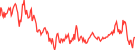
| 1.2% | 0.9% | 3.5% | 23.7% | 18.8% | 56.2% |
SN51 Converter
lium Statistics
|
Market Cap
Market Cap = Current Price x Circulating Supply
Refers to the total market value of a cryptocurrency’s circulating supply. It is similar to the stock market’s measurement of multiplying price per share by shares readily available in the market (not held & locked by insiders, governments) Read More |
$48,514,836 |
|---|---|
|
Market Cap / FDV
The proportion of current market capitalization compares to market capitalization when meeting max supply.
The closer the Mkt Cap/FDV to 1, the closer the current market capitalization to its fully diluted valuation and vice versa. Learn more about Mkt Cap/FDV here. |
1.0 |
|
Fully Diluted Valuation
Fully Diluted Valuation (FDV) = Current Price x Total Supply
Fully Diluted Valuation (FDV) is the theoretical market capitalization of a coin if the entirety of its supply is in circulation, based on its current market price. The FDV value is theoretical as increasing the circulating supply of a coin may impact its market price. Also depending on the tokenomics, emission schedule or lock-up period of a coin's supply, it may take a significant time before its entire supply is released into circulation. Learn more about FDV here. |
$48,514,836 |
|
24 Hour Trading Vol
A measure of a cryptocurrency trading volume across all tracked platforms in the last 24 hours. This is tracked on a rolling 24-hour basis with no open/closing times.
Read More |
$1,148,751 |
|
Circulating Supply
The amount of coins that are circulating in the market and are tradeable by the public. It is comparable to looking at shares readily available in the market (not held & locked by insiders, governments).
Read More |
4,072,392 |
|
Total Supply
The amount of coins that have already been created, minus any coins that have been burned (removed from circulation). It is comparable to outstanding shares in the stock market.
Total Supply = Onchain supply - burned tokens |
4,072,392 |
|
Max Supply
The maximum number of coins coded to exist in the lifetime of the cryptocurrency. It is comparable to the maximum number of issuable shares in the stock market.
Max Supply = Theoretical maximum as coded |
21,000,000 |
 Sponsored
Sponsored
Sponsored
Sponsored
Sponsored
SN51 Historical Price
| 24h Range | $11.54 – $12.05 |
|---|---|
| 7d Range | $10.36 – $12.75 |
| All-Time High |
$37.11 68.1%
Jul 18, 2025 (11 months)
|
| All-Time Low |
$6.04 95.7%
Feb 11, 2026 (4 months)
|
How do you feel about SN51 today?
About lium (sn51)
lium is a decentralized compute network that provides a peer-to-peer marketplace for renting high-performance GPU resources on the Bittensor network.
- The platform enables users to rent "pods," which are containerized GPU instances including NVIDIA H200, H100, and A100 chips.
- It operates as Subnet 51 on Bittensor, incentivizing miners to contribute computational power to a global pool.
- The network supports a variety of AI-driven tasks, such as machine learning model training, data analysis, and inference.
What Is lium
lium is a decentralized infrastructure project designed to democratize access to high-end computational power. It functions as a peer-to-peer marketplace where resource providers (miners) can list their idle GPU capacity for rent by developers and enterprises. The project aims to reduce the costs and barriers associated with centralized cloud compute providers by leveraging the decentralized nature of the Bittensor ecosystem.
Value moves through the system as users pay for compute time, and miners are rewarded based on the performance and uptime of the hardware they provide. The native token, sn51, is an application utility token used within this ecosystem to facilitate transactions and incentivize network participants. As the demand for Artificial Intelligence (AI) and machine learning compute grows, the lium network scales by attracting more miners to register their hardware, thereby increasing the total available throughput of the subnet.
What Makes lium Unique
- Decentralized Marketplace: Unlike traditional cloud providers, lium allows for a direct, peer-to-peer rental process without intermediate gatekeepers.
- Bittensor Integration: As Subnet 51, it benefits from the security and consensus mechanisms of the broader network, ensuring fair compensation and resource validation.
- Diverse Hardware Options: Users can browse and select specific GPU models based on their performance requirements, ranging from consumer-grade cards to enterprise-level Blackwell and Hopper architectures.
-
Terminal-Based Deployment: The platform offers a command-line interface (CLI) that allows developers to spin up compute instances with simple commands like
lium up.
What Can You Use lium for?
- Machine Learning Training: Developers can rent powerful GPU clusters to train large-scale models without investing in expensive physical hardware.
- AI Inference: The network provides the low-latency compute required to run AI models and serve predictions in real-time.
- Data Analysis: Researchers can utilize the distributed compute resources to process large datasets and perform complex simulations.
- Resource Monetization: Individuals and organizations with spare GPU capacity can join the network as miners to earn rewards for providing their hardware to the collective pool.
How Does lium Work?
lium operates using a subnet-specific architecture on top of the Bittensor protocol. Miners register their hardware on the network and are assigned a unique hotkey for identification. These miners host "pods"—containerized environments that users can deploy tasks into.
The network uses a Proof of Stake consensus mechanism to manage emissions and rewards. Validators on Bittensor Subnets are responsible for checking the availability, performance, and integrity of the GPUs provided by miners. Protocol service fees are paid by users to access these resources, and the system ensures that miners who provide high-quality, high-uptime hardware receive a larger share of the network rewards.
Team Info and Investors
The lium project was developed by Datura-ai, a team focused on building decentralized AI infrastructure. While specific early-stage investor details are not extensively documented in available sources, the project is a recognized part of the Bittensor ecosystem, which includes backing from various crypto-native venture firms and community contributors. The project's development is tracked through its open-source GitHub repositories.
Where can you buy lium?
SN51 tokens can be traded on decentralized exchanges and centralized crypto exchanges. The most popular exchange to buy and trade lium is Subnet Tokens, where the most active trading pair SN51/SN0 has a trading volume of $1,129,285.83 in the last 24 hours.
What is the daily trading volume of lium (SN51)?
The trading volume of lium (SN51) is $1,148,751.16 in the last 24 hours, representing a -85.20% decrease from one day ago and signalling a recent fall in market activity. Check out CoinGecko’s list of highest volume cryptocurrencies.
What is the highest and lowest price for lium (SN51)?
lium (SN51) reached an all-time high of $37.11 and an all-time low of $6.04. It’s now trading -68.10% below that peak and 95.70% above its lowest price.
What is the market cap of lium (SN51)?
Market capitalization of lium (SN51) is $48,514,836 and is ranked #458 on CoinGecko today. Market cap is measured by multiplying token price with the circulating supply of SN51 tokens (4.1 Million tokens are tradable on the market today).
What is the fully diluted valuation of lium (SN51)?
The fully diluted valuation (FDV) of lium (SN51) is $48,514,836. This is a statistical representation of the maximum market cap, assuming the maximum number of 21 Million SN51 tokens are in circulation today. Depending on how the emission schedule of SN51 tokens are designed, it might take multiple years before FDV is realized.
How does the price performance of lium compare against its peers?
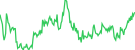
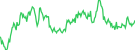
With a price increase of 3.50% in the last 7 days, lium (SN51) is outperforming the global cryptocurrency market which is down -2.50%, while outperforming when compared to similar Artificial Intelligence (AI) cryptocurrencies which are down -9.50%.
lium (SN51) Tokenomics
SN51 Unlock Schedule


lium Markets
| # | Exchange | Pair | Price | Spread | +2% Depth | -2% Depth | 24h Volume | Volume % | Last Updated | |
|---|---|---|---|---|---|---|---|---|---|---|
| 1 |
DEX
|

|
$11.91 | 0.6% | $1,044,071 | $1,040,934 | $1,129,285 | 98.31% |
Recently
|
|
| 2 |
CEX
|
$11.95 | 0.33% | $7,151 | $7,072 | $19,465.00 | 1.69% |
Recently
|
||


You may be interested in these latest crypto news


lium Guides


















 GeckoAI














 Or check it out in the app stores